




Industry spotlight in Wetzlar: GKFP and EPPA Deutschland explore the future of construction
On May 7, 2026, members of the Gütegemeinschaft Kunststoff-Fensterprofilsysteme e.V. (GKFP) and EPPA Deutschland e.V. gathered in Wetzlar to hold their annual general assemblies. The Ernst Leitz Hotel in Leitz Park provided the ideal setting for an in-depth discussion of current industry topics.
The event kicked off the evening before with a joint dinner in a modern setting. In a relaxed atmosphere, members, partner associations, and guests from the industry took the opportunity to strengthen existing networks and forge new connections.
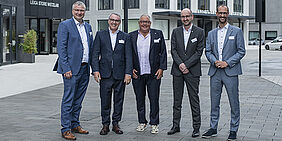
The general assemblies of both associations on May 7 were officially opened by the executive boards of both associations, led by Christian Fischer, Chairman of GKFP.
Following this, the Deputy Chairman of EPPA Deutschland e.V., Daniel Andreas, introduced the four speakers at the public lecture event, who covered a broad spectrum of topics ranging from digitalization and sustainability to damage analysis.
Focus on digitalization and data quality
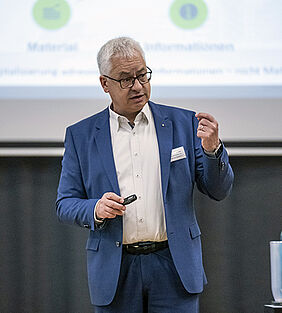
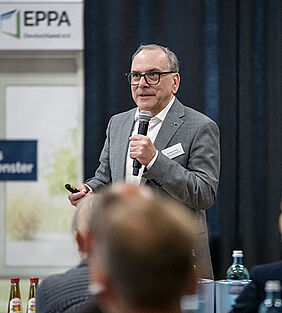
Prof. Dr.-Ing. Joaquín Díaz, Chairman of the Board of the Federal Association for Software and Digitalization in Construction (Bundesverband Software und Digitalisierung im Bauwesen e.V.), kicked off the event with an impressive overview of the drivers of digital transformation in modern construction. His central message was: “Information equals know-how.” This means that information is specifically generated, used, and shared within the context of digitalization. He emphasized that products must constantly be transported and transformed, with data quality now holding the same importance as product quality itself. The goal must be the consistent use of digital information in models.
As concrete recommendations for action, Prof. Díaz cited the systematic structuring of product data, the prioritization of BIM-relevant attributes, and the use of open interfaces. His conclusion: The industry will not become digital simply through more software, but through the reliable, machine-readable use of information along the entire value chain.
Circular Valley: The Circular Economy as a driver of innovation
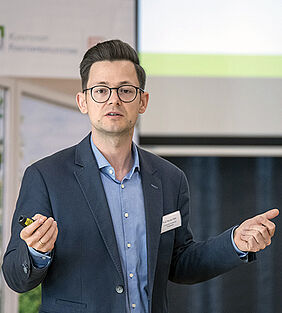
In the second presentation, Dipl.-Ing. Andreas Mucke presented the project “Circular Valley – The Silicon Valley of the Circular Economy.” As managing director of “Circular Valley,” he demonstrated how circular thinking can become a driver of innovation. Given 100 billion tons of emissions and waste worldwide each year, as well as a recycling rate of only 13% in Germany, the need for action is enormous. Mucke identified the Rhine-Ruhr region as a global hotspot for circular solutions, due to its unique scientific environment and strong industrial tradition.
The Circular Valley Foundation serves as a knowledge network connecting research, business, and startups. Mucke warmly invited attendees to deepen this exchange at the next Circular Valley Forum on November 13, 2026, in Wuppertal, as well as at the Circular Valley Convention in May 2027 in Düsseldorf.
Artificial Intelligence: opportunities and regulation
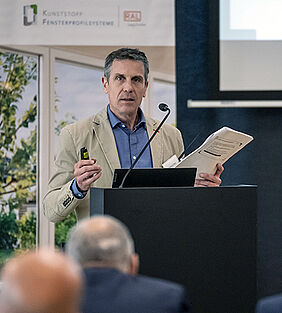
In the third presentation, Prof. Dr.-Ing. Nicolas Stein from the Technical University of Central Hesse / KITE shed light on the world of artificial intelligence (AI). While AI systems have existed for decades, modern generative AIs are opening up entirely new possibilities in production and planning, for example through intelligent 3D printers. Prof. Stein also addressed the hurdles, however: above all, the fear of job losses is slowing down development in Germany.
He also pointed out the risks: According to the EU AI Act, AI-generated content must be clearly labeled. In response to an audience question about cost trends, Prof. Stein predicted that AI applications will likely become more expensive in the future, as developers must ensure the profitability of their systems.
Systematic damage analysis for building components
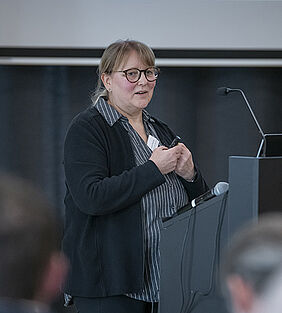
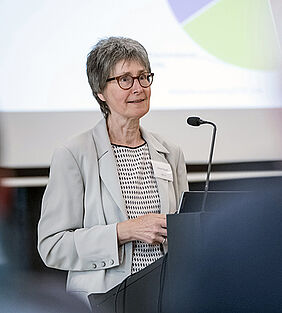
The session concluded with a presentation by Prof. Dr.-Ing. Katrin Reincke, Chair of the Executive Board at Polymer Service GmbH Merseburg, who, under the title “What damage tells us” provided insights into systematic damage analysis in accordance with VDI Guideline 3822. Using a variety of analytical methods, she demonstrated how damage, aging, and degradation processes in PVC profiles can be investigated.
Using a specific case study, Prof. Reincke illustrated that damage rarely has a single cause. Rather, it is the result of an interplay of several factors: design details (such as standing water on rebate edges), microclimatic influences (biofilms caused by pollen or algae), as well as maintenance and cleaning by the user. The expert’s conclusion: In many cases, damage analysis is characterized by a high degree of complexity and a correspondingly demanding nature. However, the diversity of plastics and plastic products, as well as their interactions with the environment, also lend this field of work a special excitement and versatility.
The free program was followed by the compulsory program
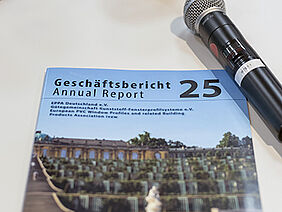
Following these technical presentations, the two associations held their regular internal general assemblies in the afternoon. In addition to the annual reports, the focus was on strategic direction and future collaboration.
Daniel Andreas first informed those present about personnel and structural changes at the office, including the introduction of Stefan Frye as the new managing director of both associations, and warmly welcomed the new members.
A key agenda item was the presentation of the results from the previous strategy workshop, particularly the formulation of the vision and mission for each association. Building on this, Daniel Andreas presented the planned projects and initiatives that will significantly shape the associations’ work in the coming period.
Proposals for amendments to the statutes of EPPA Deutschland e.V., intended to reflect the association’s new direction, were also discussed.
On behalf of the office, Ulrike Quiehl and Bernhard Elias provided an update on the current status of the revision and streamlining of RAL-GZ 716 as well as the Technical Annex.
At the conclusion of the meeting, the necessary procedural matters under association law were addressed.
This year, this also included a by-election to the Quality Committee. Carsten Schäfer (aluplast GmbH) stepped down from the committee after 20 years of service and nominated Dominik Mathes (also of aluplast GmbH) as his successor. Under the chairmanship of Peter Czajkowski, Dominik Mathes was unanimously elected into the Quality Committee. The Gütegemeinschaft would like to take this opportunity to thank Mr. Schäfer for his many years of commitment to quality assurance and the Gütegemeinschaft and warmly welcomes Mr. Mathes to the committee.
The participants left Wetzlar with a positive summary of the meeting.
The date for next year’s general assemblies will be announced this summer.
Those interested can find more information about the program on the websites of the GKFP e.V. and EPPA Deutschland e.V.
Images © Sarah Heuser/ GKFP e.V.
© Sarah Heuser/ GKFP e.V.
© Sarah Heuser/ GKFP e.V.
© Sarah Heuser/ GKFP e.V.
© Sarah Heuser/ GKFP e.V.
© Sarah Heuser/ GKFP e.V.
© Sarah Heuser/ GKFP e.V.
© Sarah Heuser/ GKFP e.V.
© Sarah Heuser/ GKFP e.V.
© Sarah Heuser/ GKFP e.V.
© Sarah Heuser/ GKFP e.V.